Twenty-Five Centuries in Two Hundred Metres
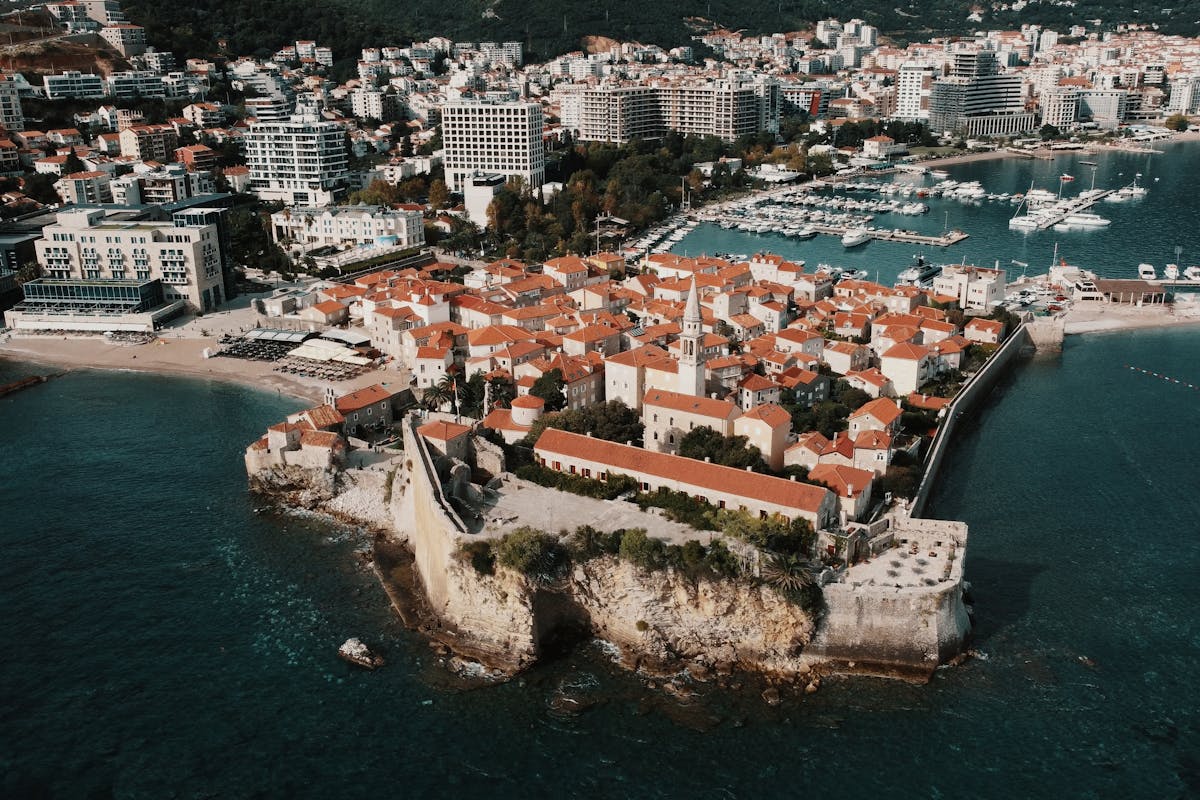
The old town peninsula juts into the Adriatic like a clenched fist. Greeks settled here around 500 BC, and every century since has left its fingerprint in the stone. You can trace them if you know where to look: a chunk of Cyclopean wall near the eastern gate, a Roman floor hidden beneath a jewellery shop, Venetian lions carved above doorways, and Austrian-era facades painted in terracotta and ochre. The 1979 earthquake flattened much of it, but the rebuild used original stone and stayed faithful to the medieval street plan.
Walking the old town properly takes about ninety minutes if you include the citadel and the churches. Start early, by ten o'clock in summer the cruise-ship groups arrive and the narrow lanes get congested. Early morning light also hits the eastern walls perfectly, which matters if you are carrying a camera.
Enter Through the Main Gate
The main land gate faces the modern town across a small stone bridge. Above the archway, a carved relief of the Budva coat of arms greets you, a stylised fish above waves, with a crown. Pass through and you step onto polished limestone paving that generations of feet have worn smooth. Immediately to your left, a narrow staircase leads up to the rampart walk. Take it. The elevated path runs along the northern wall and gives you a bird's-eye map of the old town before you descend into its lanes. From up here you can see all four churches, the citadel tower, and the harbour where fishing boats still tie up each morning.
Three Churches, Three Stories
Holy Trinity Church
This compact Orthodox church sits in the square just inside the main gate, dwarfed by its neighbours but impossible to miss thanks to the distinctive striped stonework, alternating bands of grey and pink. Built in 1804 during a brief period of Russian protection, its interior holds gilded icons and a painted ceiling that catches afternoon light through a single high window. Look for the tomb of Stjepan Mitrov Ljubiša, a 19th-century writer and statesman, set into the outer wall.
St. John's Church
The tallest bell tower on the peninsula belongs to this Catholic church, rebuilt after the 1667 earthquake and again after 1979. Inside, a Madonna and Child icon draws steady pilgrimage traffic. The church library once held one of the finest manuscript collections on the Adriatic coast, though most pieces moved to Cetinje for safekeeping centuries ago. The bell tower is not open to climbers, but it frames the best photos of the old town from the harbour side.
Santa Maria in Punta
Tucked against the citadel walls at the peninsula's southern tip, this ninth-century church is the oldest surviving structure in Budva. It is small, more chapel than church, and services stopped long ago, but the stone shell endures. Local legend says the building was assembled from pieces of an even older church that stood on the same spot. The acoustics inside are remarkable, and it occasionally hosts small concerts during the summer theatre festival.
The Citadel Terrace
The Citadela anchors the southern end of the peninsula. Entry costs a few euros and grants access to the rampart walls, a small library, and the open-air restaurant terrace on top. The terrace view is the reason to come: the Adriatic stretches west toward Italy, Sveti Nikola island sits directly offshore, and on clear days the Albanian mountains show as a faint grey line to the south. Sunset from up here, with a glass of Vranac wine, is the single best moment Budva offers. The citadel also houses a modest museum with Roman and medieval finds, pottery shards, coins, and a relief map showing the town before the earthquake.
Where the Walk Leads Next
Exit the citadel and loop back along the southern sea wall. A wooden boardwalk hugs the cliff edge and leads to Ricardova Glava, the old town's tiny beach wedged between the fortress walls and the rocks. It fills fast, but a late-afternoon swim here, looking up at the stone ramparts, is hard to beat. From the boardwalk, steps climb back into the lanes near the harbour. If your legs and appetite are both still going, continue to the waterfront restaurants just outside the walls for the best of the gastro scene.
Practical Tips
- Best time: Before 9am in summer, or after 6pm when the tour groups leave and the light turns golden.
- Footwear: The polished limestone paving is slippery when wet. Flat shoes with grip are essential after rain.
- Photography: Morning light hits the eastern walls and harbour. Sunset rewards from the citadel terrace facing west.
- Off-season: October through April the old town is almost empty. Cafes stay open, the citadel is quieter, and you can photograph the lanes without a single person in frame.
At a Glance
Car rental FAQ
Parking and access questions for driving to Budva Old Town.
Can I drive into Budva Old Town?
No. Stari Grad is fully pedestrianised inside the walls. Park at the perimeter and walk in through one of the gates; it is a two-minute walk from the nearest lot.
Where is the closest parking to the Old Town gate?
The metered Slovenska street bays and the Slovenska Plaža lot are both a short walk from the main gate. The TQ Plaza underground is the covered option for a longer stay.
How much is parking near the Old Town?
Paid bays run by the hour in summer with a daily cap, and are free from November to April. Rates are shown on the kiosk; the underground lot is the priciest but never full.
Is a car useful if I am mainly seeing the Old Town?
Only if you are also day-tripping to Sveti Stefan, Kotor or the beaches. For the Old Town alone you walk everywhere, so pick the smallest car and park once.
Live prices and availability for your exact dates.
Free cancellation available on most cars